






The Complete Guide to Nose-to-Tail Eating

By Grazly Editorial Team · Updated 2026-08-13
Nose-to-tail eating delivers concentrated micronutrients that muscle meat alone doesn't provide — B12, iron, and choline among them, found in liver and other organ meats. This guide looks at why the whole-animal approach has stuck around for as long as humans have eaten meat, what makes organ meats nutritionally distinct, and how to think about sourcing grass-fed, pasture-raised beef with nose-to-tail eating in mind.
Key Takeaways
-
Nose-to-tail eating represents one of the hottest and healthiest culinary movements gaining popularity today.
-
Organ meats like beef liver, kidney, and heart provide nutrient-dense nutrition beyond standard muscle cuts.
-
The Paleo and Carnivore Diet communities have significantly popularized organ meat consumption in recent years.
-
Nose-to-tail eating remains the standard practice across South America, the Middle East, and Asian meat markets.
What Is Nose-to-Tail Eating and Why It Matters?
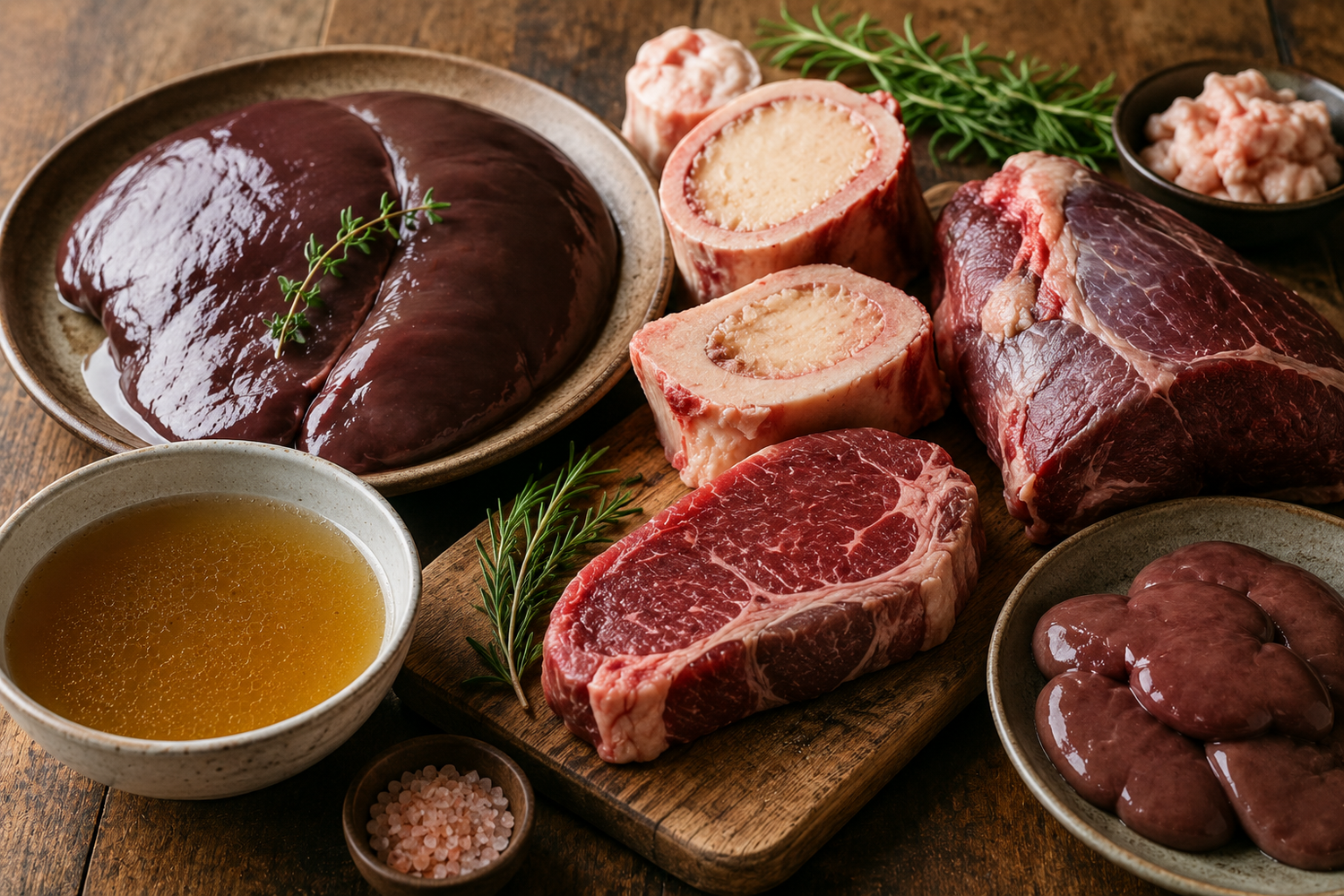
Nose-to-tail eating means consuming every edible part of an animal, not just the muscle cuts stacked in a supermarket case. Skin, cartilage, bone marrow, tendons, and organs all belong on the plate under this model. Modern shoppers who skip these parts are missing most of the nutritional picture that once defined human diets.
This approach is not new. Nose-to-tail eating reflects how humans ate for nearly the entirety of human evolutionary history, spanning close to two million years. Early humans did not have the luxury of discarding organs or bones. Every part of a hunted animal served a purpose.
Why did eating the whole animal matter for human evolution?
Early humans relied on bone marrow and organ meats for concentrated nutrition unavailable elsewhere in their diet. Some anthropologists connect this nutrient density to the expansion of the human brain over evolutionary time — a hypothesis often discussed alongside the broader shift toward more energy-dense foods in the human diet. Whatever the precise mechanism, it's clear that skipping these parts of the animal would have left ancestral humans without a meaningful share of the nutrition available to them.
Why does this matter for health-conscious eaters today?
Modern diets have quietly moved away from this ancestral pattern, favoring lean muscle meat almost exclusively. Grazly's mission centers on restoring balance by making nutrient-dense nourishment from the whole animal accessible again. For anyone chasing a more complete, ancestral approach to eating real food, reclaiming this practice offers a way back to the kind of nutrition human biology developed around.
Why Are Organ Meats So Nutrient-Dense?
Nutrient density in organs comes from concentrated vitamins and minerals that muscle tissue simply doesn't carry in the same amounts. Skipping these cuts costs consumers a wide swath of nutrition that steak and ground beef alone can't replace. Organ meats and bones carry nutritional profiles that complement what muscle meat provides, rounding out a diet that would otherwise be nutritionally lopsided.
Part of the importance of organ meats lies in amino acid balance. Muscle tissue supplies abundant methionine, while bones and cartilage supply abundant glycine. Both amino acids perform distinct, vital functions in the body. A diet weighted too heavily toward muscle meat skews this ratio, and that imbalance is one reason nutritionists increasingly point to collagen-rich and organ-rich foods as a counterbalance to a muscle-meat-only approach.
This is part of why traditional cooking so often paired muscle meat with bone broths, marrow, and organ-based dishes rather than serving steak on its own — not by coincidence, but because it naturally balanced out the amino acid profile of a meat-heavy diet. Modern eating patterns, built almost entirely around boneless, skinless cuts, have quietly dropped that balance without most people noticing.
What makes organ meats different from muscle meat nutritionally?
Organ meats introduce a far wider variety of nutrients than a diet built solely around muscle cuts. This variety is central to genuine organ meat benefits — nutrients like vitamin A, B12, iron, and CoQ10 that muscle tissue rarely delivers in comparable amounts.
Does the animal's diet affect organ meat nutrient density?
Sourcing matters. Grazly positions its grass-fed, regeneratively raised beef as a source of bioavailable vitamins and minerals, with cattle finished entirely on open pasture rather than grain feedlots. That distinction directly shapes the nutrient profile landing on the plate — and it's one reason nose-to-tail eating pairs naturally with a focus on where and how the animal was raised, not just which parts end up on the table.
Pasture access, forage diversity, and how the land itself is managed all feed into the final nutritional profile of the meat — organs included. Cattle raised on well-managed, biodiverse pasture tend to produce organ meats with a stronger nutrient profile than those raised in more industrial conditions, which is part of why sourcing and whole-animal eating tend to go hand in hand for people serious about nutrient density.

What Health Benefits Can Organ Meats Deliver?
Organ meats are among the most nutrient-dense foods available, and that density is linked to a range of general health benefits — supporting energy metabolism, immune function, and healthy inflammatory response, largely through nutrients like vitamin A, B12, iron, zinc, and CoQ10. These are well-established roles for well-established nutrients, though how much any individual notices day-to-day depends heavily on their starting diet and overall health.
It's worth being upfront about the limits of what diet alone can do here. Organ meats are a genuinely valuable source of nutrition, but they aren't a treatment for any diagnosed condition, autoimmune or otherwise — those are managed with a doctor's guidance, and diet is best thought of as a supporting piece of overall health rather than a substitute for medical care. If you're managing a chronic condition and considering major dietary changes, it's worth talking to your doctor first, especially around any changes to medication.
For the ancestral-eating and nose-to-tail communities, the appeal isn't a promise of curing anything — it's the straightforward case that organ meats pack more nutrition per bite than almost any other food, and that skipping them means leaving real nutritional value on the table.
How does organ meat fit into an ancestral or nutrient-focused diet?
Most people don't need to eat organ meats daily to benefit from including them — even a serving or two a week can meaningfully round out a diet that otherwise leans entirely on muscle meat. Liver, kidney, and heart each bring something slightly different to the table nutritionally, which is part of why rotating between them tends to work better than relying on just one.
What's a reasonable way to start if you're new to organ meats?
Starting small tends to work best — a modest serving of liver blended into ground beef, or a slow-cooked heart stew, is an easier entry point than a large plate of liver on its own. From there, most people find their tolerance and taste for organ meats grows with repeated exposure, making it easier to build them into a regular rotation over time. Bone broth is another low-friction entry point, since it delivers some of the same nutritional benefits in a familiar, easy-to-drink form before working up to organ meats themselves.
For carnivore, paleo, and ancestral-eating practitioners alike, this is the real case for moving organs from garnish to staple: not a promise of reversing disease, but a straightforward nutritional upgrade that's easy to build into an already meat-centered diet.


Leave a comment
This site is protected by hCaptcha and the hCaptcha Privacy Policy and Terms of Service apply.